



By Chris McGrath
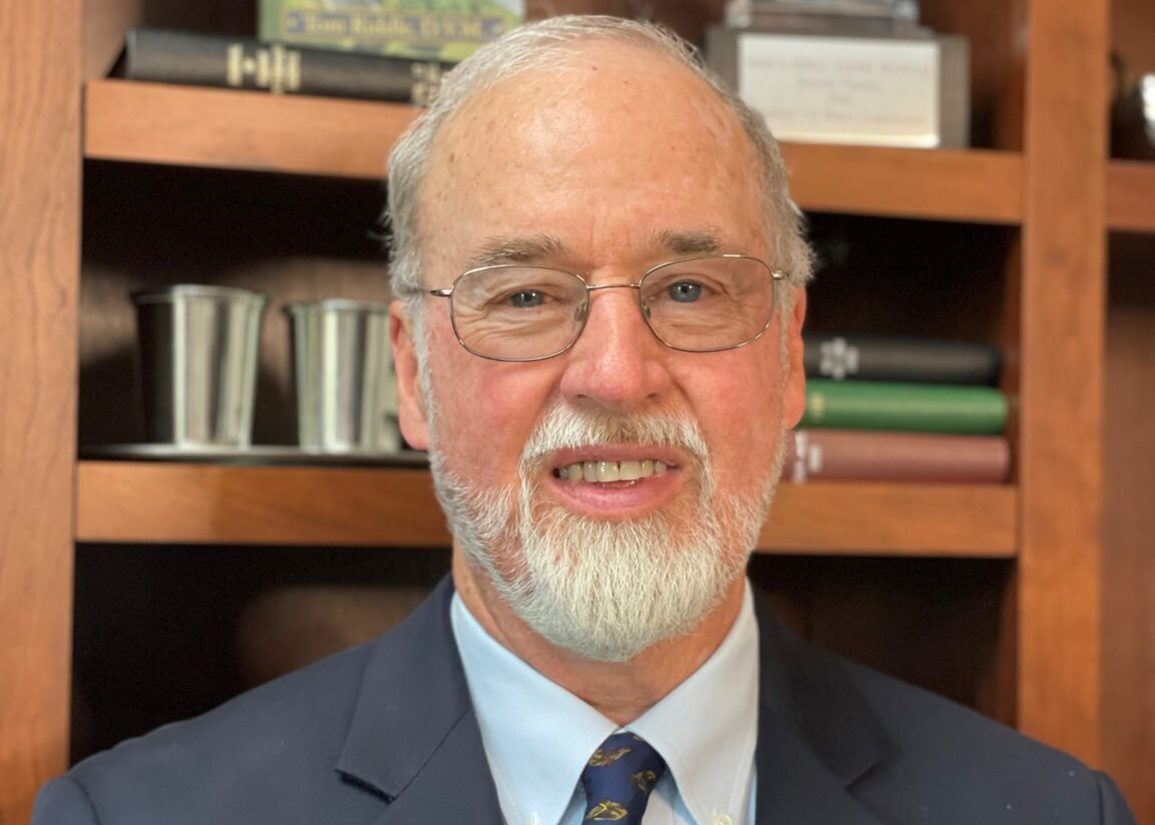
Dr. W. Thomas “Tom” Riddle, who as co-founder of Rood & Riddle quietly threaded his name into the daily fabric of horse country, died September 20 after a long illness. He was 74.
This was not a case of nominative determinism: seldom has a Riddle been so straightforward. However understated his character, there was nothing elusive about one whose veterinary expertise was harnessed to equally exceptional integrity and courtesy.
“The first word that comes to mind is 'gentleman,'” said his old friend, John Williams. “Tom was a quiet giant. Very reserved in his demeanor, very professional, wore a necktie—but just a pleasure to be around, a wonderful, hard-working guy and so highly respected. My God, he was a talent. To think how he and Bill Rood started out, operating out of Bill's garage in Chevy Chase, Lexington. Today Rood and Riddle is arguably the most highly respected equine surgery in this country, if not the world.”
Riddle was born in Greenville, South Carolina, on 7 June 1952. Though for a time tempted by human medicine, he discovered that being around sick or injured people made him profoundly uncomfortable. And, besides, he missed being around horses and horse folk. So he ended up emulating his father, a veterinarian, and switching to animal medicine.
After graduating from the University of Georgia in 1978, Riddle spent four years at Spendthrift Farm, initially as an intern. Williams, who was then managing the farm, recalled how resident veterinarian Dr. Don Witherspoon, a University of Georgia man himself, would return to his alma mater every year or two and ask for their best young talents.
“So he always had a couple of young assistant veterinarians,” Williams explained. “And one of them was this fellow named W. Thomas Riddle. It was a particularly cold winter. And this guy was about big around as your ballpoint pen, tall and skinny. And he was up there in Barn A, with that wind blowing through, and I thought to myself, 'This pimply-faced, skinny son-of-a-gun, he'll tough it through and then beat it right back to South Carolina.' Well, the rest is history.”
Spendthrift divided its own mares and those belonging to clients between two different managers. At the end of his first season, both wanted the skinny guy. One of them, Rick Nichols, would have to wait until he was running Shadwell to nail down that privilege.
Williams had himself left Spendthrift to operate his own small farm when he invited Riddle to lunch, and asked whether he might handle his veterinary work. “John,” Riddle replied. “You're my first client.” (Maybe Rood already had one; or maybe their partnership had its own account. But to this day Williams, asked for his account number, can say: “Two.”)
That was 1982. Before long Rood and Riddle were in such demand with the biggest farms that Williams was grateful simply to have Riddle recommend a replacement.
“They were two guys with their equipment in the trunks of their cars,” Williams marvels. “And they were up against Hagyard, Davidson and McGee, founded 150 years ago and still one of the foremost equine hospitals and practices in this country. But look what Rood and Riddle has become in the meantime. I bet on their masthead there must be 100 veterinarians. They're in three states: a surgery in Saratoga, a facility in Florida, and of course the home base here. It's just amazing.
“Bill Rood was the driving force, to keep building it bigger and better. And Tom was the guy in the field, establishing and maintaining one of the most coveted client bases in the area.”
Williams notes how the partnership was sustained by unerring recruitment, bringing in the likes of Rolf Embertson and Larry Bramlage. But never would Riddle show a sharper eye for a special human being than when a young woman named Margaret Alexander arrived at Spendthrift.
Williams remembers her driving into the farm in a van full of furniture belonging to Mr. and Mrs. Don Snellings, as part of a package hired from Virginia to manage the yearlings. “And I guess Tom bowed his neck!” Williams says with a chuckle.
It was a whirlwind courtship. Interviewed in his late 60s, Riddle admitted that they had only been dating “about six weeks” before they married.
“I would never recommend that to my children,” he said. “I would never recommend that to anyone! But for Margaret and me, it was right. She still is a beauty. She'd moved to Kentucky to work with the yearlings at the farm. She was beautiful, she was smart, and she knew horses very well. One of the veterinarians, who worked with Margaret more than I did, set us up and invited us to dinner at his house. Before that, I had seen her almost from a distance. But that night, when we went to dinner, I thought: 'This is the woman for me.'”
They married on 6 February 1981—right before the breeding season. It was a very short honeymoon. Luckily, Margaret understood the business well enough to understand. But once they commenced their own breeding (they had a daughter, Peden, and sons Alexander and William), Riddle made it a rule always to be home for dinner—albeit his working day, as a reproduction specialist, would not necessarily be over. Night-time foalings wait for no man.
The other big partnership in Riddle's life was established with a young vet who had visited Spendthrift one day. When he was thinking of leaving Spendthrift, he met Dr. Bill Rood several times for a drink: they found that they complemented each other ideally, both in character and professional attributes, and worked out a deal.
“A lot of it was luck, I would have to say that,” Riddle said in the same interview. “He was more interested in the business end of veterinary medicine, I was more interested in the hands-on. So it worked out very well for us. I did talk with several other people about possibly going in with them, but with Dr. Rood, it just seemed like it was going to be easy.”
While they obviously couldn't carry on forever, working out of that garage, Riddle wasn't especially looking to establish a big practice or hospital. After a year, they moved into a kind of warehouse and Riddle assumed that those premises would suffice for now. Really all he wanted to do was work with his beloved broodmares. But his partner remained eager to keep moving forward. “So I was kind of along for the ride!” Riddle recalled. Both kept an eye open for a suitable plot, driving between farms, and one day Riddle noticed a site on Georgetown Road. It was far too big, 206 acres, but had been stagnating for a while and the vendors agreed to break off a 24-acre parcel. Rood and Riddle broke ground in July 1985, and told the contractor that he would only be paid in full if they were installed in six months. He came through, and they opened for business the following February.
Another surgeon was needed to assist the expansion, but interviewees tended to prove reluctant to throw in their lot with a couple of young guys in Kentucky who, as Riddle recalled, didn't quite know where they were trying to go. “But we had a lot of dreams,” Riddle said. “Neither Dr. Rood nor I was ever very worried about the future. We just thought if we do things right, things are going to turn out.” He found Embertson at Ohio State, and was forever grateful that he agreed to come aboard, as “a wonderful surgeon and a wonderful person who has meant so much to our practice.”
In the course of his career, Riddle proceeded to countless accolades. He served as president of the Kentucky Association of Equine Practitioners, the Society for Theriogenology, and the Theriogenology Foundation. He received the Steiner Award for Excellence in the Practice of Theriogenology, and honorary membership of the American College of Theriogenologists. He was recognized as a Friend of the University of Kentucky Ag Equine Programs, UGA College of Veterinary Medicine Dean's Distinguished Service Award, and the Distinguished Educator-Mentor Award from the American Association of Equine Practitioners. In 2023, he was appointed to the Kentucky Horse Racing Commission.
To many, his greatest distinctions were less formal: as a family man, above all, and a professional mentor. In his own career, however, perhaps his single greatest service came in 2001, during the terrifying outbreak of what became known as Mare Reproductive Loss Syndrome.
Williams remembers Riddle coming to check on the handful of mares he had retained in semi-retirement.
“Tom would come to check them at 42 days,” he said. “And he'd come back out and say, 'No heartbeat.' That's when they got together, Tom and our dear friend Dr. Richard Holder from Hagyard, and figured out what was causing this. Those damned caterpillars. After that, the cherry trees were cut down all over the farms. He was brilliant. Beyond a guy that just squeezes ovaries, he was a scientist.”
“My whole career, you run into problems and you don't throw up your hands and say, 'No, I'm never going to do this,'” Riddle himself reflected once. “You figure out a way to make it work.”
Williams recalled one of his own mentors, in Maryland, who once said to him: “Well, John, we'll make some mistakes together, but one mistake we will never make is one of omission.”
“And that was Tom Riddle, too,” Williams said. “He was thorough. Never skipped over anything. He didn't go from one to four. He always went one, two, three, four. So he needs to be recognized for what he did. Not just for his profession, but for the industry overall. Always so quietly, but we're all better off for having had W. Thomas Riddle in this game—as am I, for having had him in my life.”
In addition to Margaret, Riddle is survived by their daughter, Peden Riddle Fraley (Bryan); their sons, Alexander Landstreet Riddle (Emily) and William Davis Riddle (Neely); his sister, Jessica Riddle Curlee; his brother, John Newby Riddle; and his grandchildren, Adeline Davis Fraley, Harrison Anne Fraley, John Woodford Riddle, Charlotte Louise Riddle, and another grandson on the way, William Thomas Riddle II. He was preceded in death by his brother, Herbert Earle Riddle, Jr.
A gathering of family and friends will be held from 4 p.m. to 7 p.m. on Monday, 28 September at Clark Funeral Home, Rose Hill, in Versailles, Kentucky. A Memorial Service will be held at 11 a.m. on Tuesday 29 September, at the Church of the Ascension in Frankfort, Kentucky, with Rev. Mr. Peter Doddema officiating.
In lieu of flowers, memorial contributions may be made to the Bluegrass Farms Charities, P.O. Box 12252, Lexington, KY 40582, or www.bgfcky.org.
Not a subscriber? Click here to sign up for the daily PDF or alerts.